 The result is a car that can go from 0-62 mph in 2.9 seconds, hit a top speed of over 250 mph and achieve 1.4g on the skidpad. That kind of performance comes at a price, though, with the CXXR listing for €1,575,000. No word on how many CCXRs Koenigsegg plans to produce.
 When thinking about super cars, one of the last things that spring to mind is their environmental friendliness. Even though the very low and exclusive production volume of Koenigsegg can hardly be considered to have a measurable impact on the Co2 problem that global society is facing, it is an impressive statement that even a small and extreme company like Koenigsegg can afford to develop environmentally focused solutions.
 By following conscientious and forward thinking strategies, Koenigsegg has managed to create CCXR with even more spectacular performance than the standard CCX. These two almost conflicting results are made possible due to the simple fact that the ethanol in bio fuel has the positive side effect of cooling the combustion chambers, as well as a higher octane value, well over 100 RON, which gives the high power. Due to the fact that the bio fuel has higher octane and cooling characteristics, the torque has gone to 1060 nm at 6100 rpm. It is natural to expect a substantial gain in power when optimizing the engine for E85(biofuel) instead of Petrol. Still the actual gain obtained even surprised the enthusiastic engineers at Koenigsegg. Following the long term strategy of Koenigsegg, all previous CCXs will have the possibility to be converted by the factory to accept the biofuel option and reap the performance and environmental benefits of this wonderful and eco friendly fuel. The CCXR Biofuel upgrade has been developed in-house on the factory's engine dyno by the skilled technicians at Koenigsegg, led by Christian Koenigsegg, Marco Garver and Anders Hoglund from the Koenigsegg partner company Cargine Engineering. Curiously enough the CCXR is the first homologated car currently in production to reach over 1000 BHP. Coupled with its gorgeous looks, the Swedish super car is sure to be on the Christmas list of corporate big-wigs everywhere.
 The car is more track biased compared to the standard models, as it has stiffer springs and anti-roll bars, reset dampers and lowered chassis. It also features a fully visible carbon body a large adjustable rear wing, larger front splitter and side strakes for increased down force and a unique forged wheel design. The interior is also reworked and features; color matched leather carpets, Edition side step plates, Edition chronograph instrument cluster, New edition only layout for the center console control panels. All other extra equipment comes as standard, such as Carbon Wheels, Special interior trim and color, Rear view camera, Satnav or Bluetooth, Amplifiers, complete Inconell exhaust system in order to save weight. The two first of each version are already spoken for. Unveiling of the Edition versions will be at the Geneva Motor show in March 2008, where the first delivery will take place.
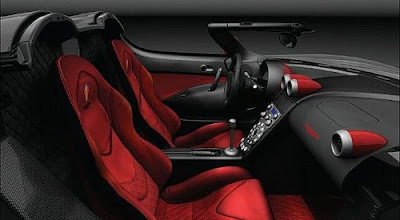 The CCXR will take you to an entirely new level of performance. The CCXR is the first green supercar in the world and thereby sets a great example for others to follow. Since the ethanol in E85 fuel has a much higher octane rating and internal cooling capacity, the engine can run with higher compression, boost pressure and more spark advance compared to the normal petrol-fuelled CCX, whilst still maintaining the same exhaust temperature.
Weight-to-power ratio is 2.76 lb/hp. Torque is 782 ft-lb (1,060 Nm). The CCXR can achieve 62 mph (100 km/h) in 3.1 seconds. Christian von Koenigsegg is quoted as saying, "Our engineers couldn't quite believe the figures when we tested the car". The increased power is a result of the cooling properties of ethanol in the engine's combustion chambers allowing for a higher pressure in the cylinder and the biofuel having a higher octane rating of 113 RON compared to 95 RON for gasoline in North America and 100 RON for gasoline in Europe, although the CCXR burns slightly more fuel than the CCX with about 15 mpg (17L/100km). The only changes to the engine are modified fuel injectors, upgraded fuel lines and piston rings and a higher boost setting on the superchargers.


 The Clan Crusader typically had a Glass Reinforced Plastic (GRP) Monocoque (French for single [mono] and shell [coque]), body with Hillman Imp Sports Engine from the Rootes Group (later Chrysler Europe).
 The Clan Crusader was designed by a group of engineers who had previously worked for Lotus and were led by Paul Haussauer with John Frayling focusing on the styling. The Clan company was set up in 1969, and production started in 1971 at a new factory in Washington set up with the help of a government grant.
 The Clan Crusader was available fully built or in a kit version. Although the car received good reviews and achieved some competition success, it was expensive at £1,400 when compared with rivals and as a result the company shut down in November 1973. Total production of the first phase of the Clan Crusader was 315.
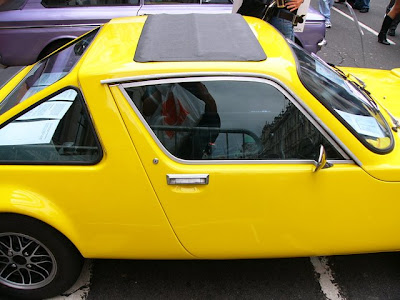 The exact specs of the Clan Crusader (licence plate: NYL 7L) in these Car Journal photos are as follows:
 Engine
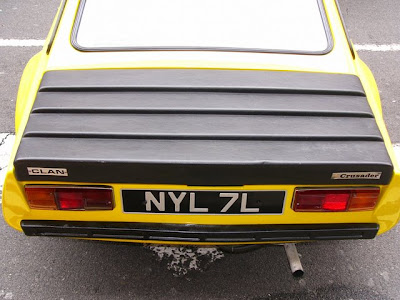 Transmission
 This Clan Crusader has been an on-going restoration project since 1992 and the car has been off the road and dry stored. It was put back on the road for the Clan Owners Club 30th anniversary on 1st June 2008.

 The Porsche Panamera is the fifth range from Porsche (Porsche Boxter, Porsche Cayman, Porsche 911, Porsche Cayenne) and is developed to be a strong competitor to the Volkswagen four-door coupé, the future Aston Martin Rapide and the Mercedes CLS.